

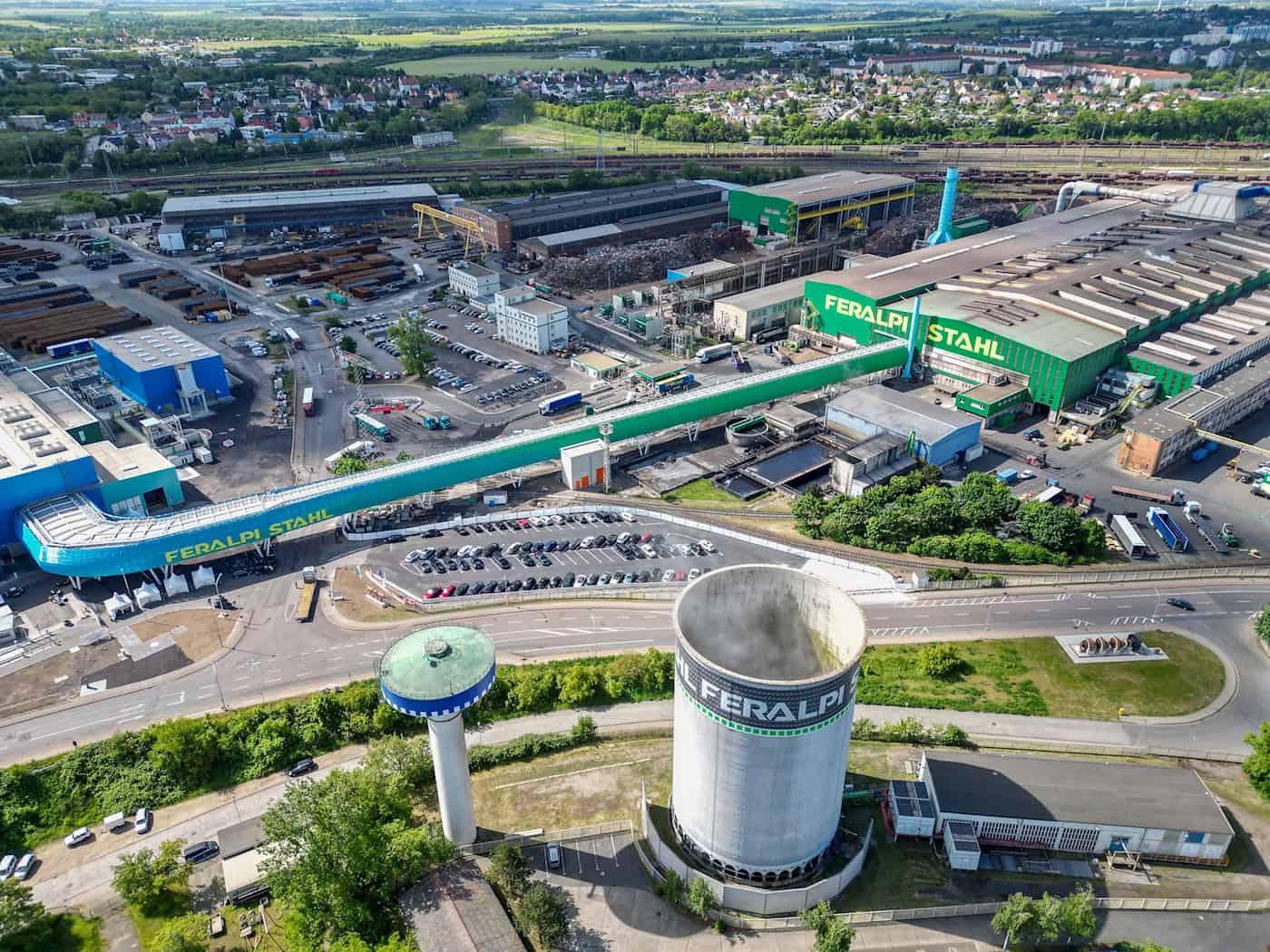
One year after commissioning its new emission-free rolling mill, steel manufacturer Feralpi plans to significantly increase production capacity at the Riesa site. According to the company, steel production is set to grow from the current level of around one million tons to up to 1.3 million tons per year. The basis for this is the further ramp-up of the so-called spooler rolling mill, which was opened in May 2025. The plant produces special structural steel for automated applications and is now being operated in two shifts, according to the company. Performance tests are continuing in parallel with plant manufacturer Danieli. The aim is to achieve final acceptance of the plant in the summer. "With the new spooler rolling mill, we have created the conditions to raise our production to a new level," said Feralpi manager Uwe Reinecke. The ramp-up is proceeding according to plan and the new product is increasingly establishing itself on the market. Production Director Dariusz Sosin also gave a positive interim assessment. The desired material properties were already evident during the ramp-up phase, he explained. "The processes are working and we are achieving a very consistent product quality." The existing rolling mill in Riesa currently produces around 850,000 tons of structural steel per year, according to the company. In the future, the new plant will also produce around 400,000 to 450,000 tons of coiled reinforcing steel for automated further processing. Three-shift operation is planned for this from 2027. However, further growth in demand and additional investments in scrap processing are a prerequisite. In total, the Feralpi Group says it is investing more than 220 million euros in the Riesa site. In addition to the expansion of rolling capacities, the program also includes measures in scrap processing as well as energy and infrastructure. According to the company, the new spooler rolling mill does not cause any direct CO2 emissions during production. This is made possible by an inductive heating system that does not require fossil fuels. Copyright 2026, dpa (www.dpa.de). All rights reservedNew rolling mill enters next phase
Up to 1.3 million tons of steel per year planned
Production without direct CO2 emissions


