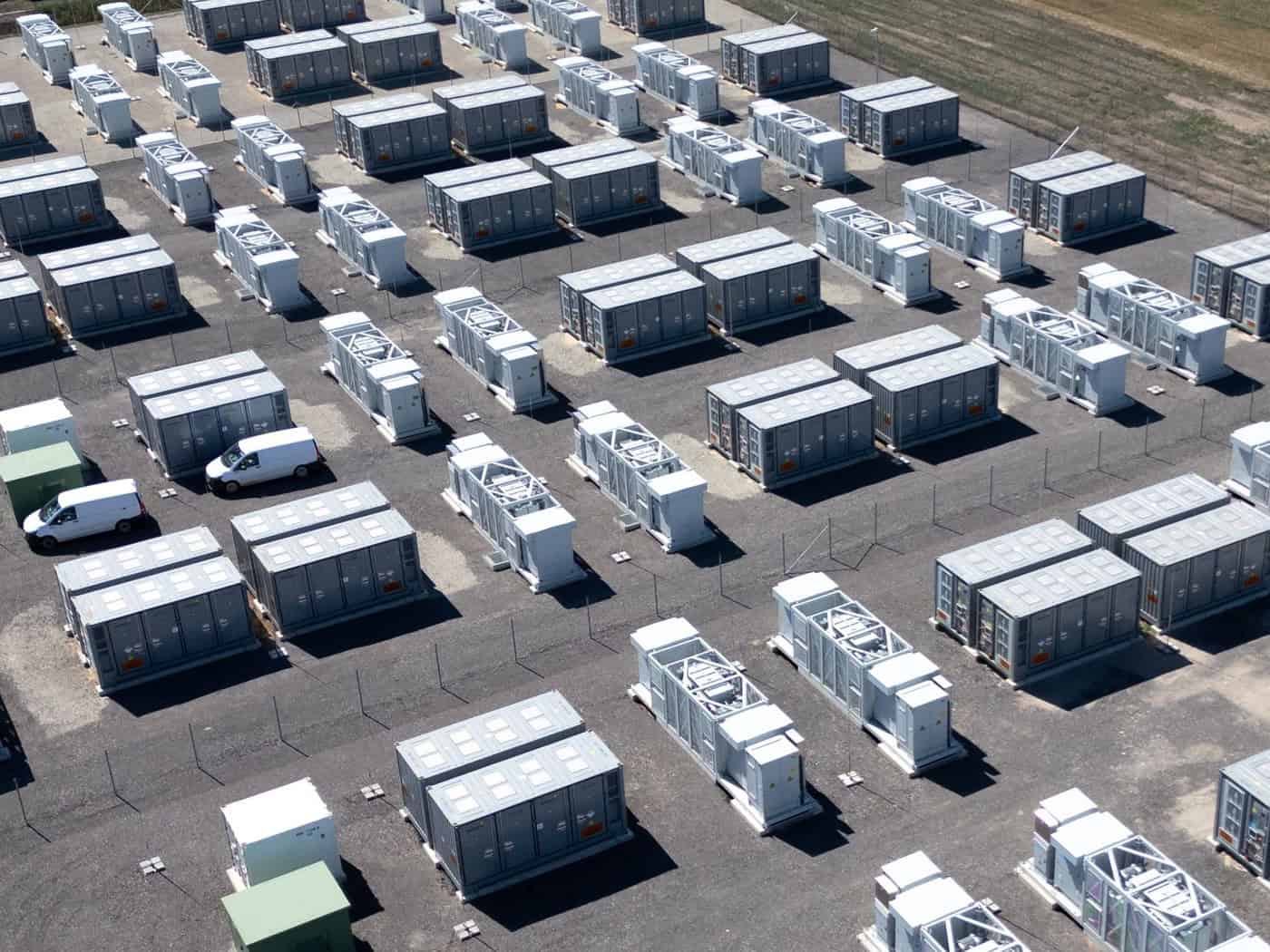
The Saxony State Directorate has given the green light for the planned large-scale battery storage facility near Freiberg. As a result, the project now has building permits, according to the State Directorate. The Danish company CI V Gigastar ProjectCo GmbH is planning a battery storage facility in Wegefarth, a district of Oberschöna in the Mittelsachsen district, with a maximum output of 700 megawatts (MW) and a storage capacity of approximately 2,800 megawatt-hours. In purely mathematical terms, this would be enough to cover the average daily demand of a major city with approximately 250,000 to 300,000 households. “A project of this scale is unprecedented in Saxony,” said Béla Bélafi, president of the Saxony State Directorate. As the planning approval authority, they have thus broken new ground. The goal of the mega-battery is to store electricity when there is a surplus and feed it back into the grid when it is needed. “The new generation of battery storage systems will help us in the future with the energy transition and with the stability of the power grid,” explained Bélafi. This is also expected to lead to more stable electricity prices. The mega-storage facility is to be connected to the existing Freiberg Nord substation in Wegefarth via a new substation and an underground cable connection. On a site covering approximately 11 hectares, two units—one with a capacity of 500 MW and the other with 200 MW—are to be constructed in two phases. According to the State Directorate, there were about 100 objections during the planning approval process, 66 of which came from private individuals and two from nature conservation organizations. These objections were addressed during the planning approval process. Starting Monday, the decision will be publicly announced and will be available online for two weeks. Provided no one takes legal action against the planning approval decision, the project can proceed. Copyright 2026, dpa (www.dpa.de). All rights reservedStorage Facility Could Power a Major City for One Day
Storage Stabilizes the Power Grid