

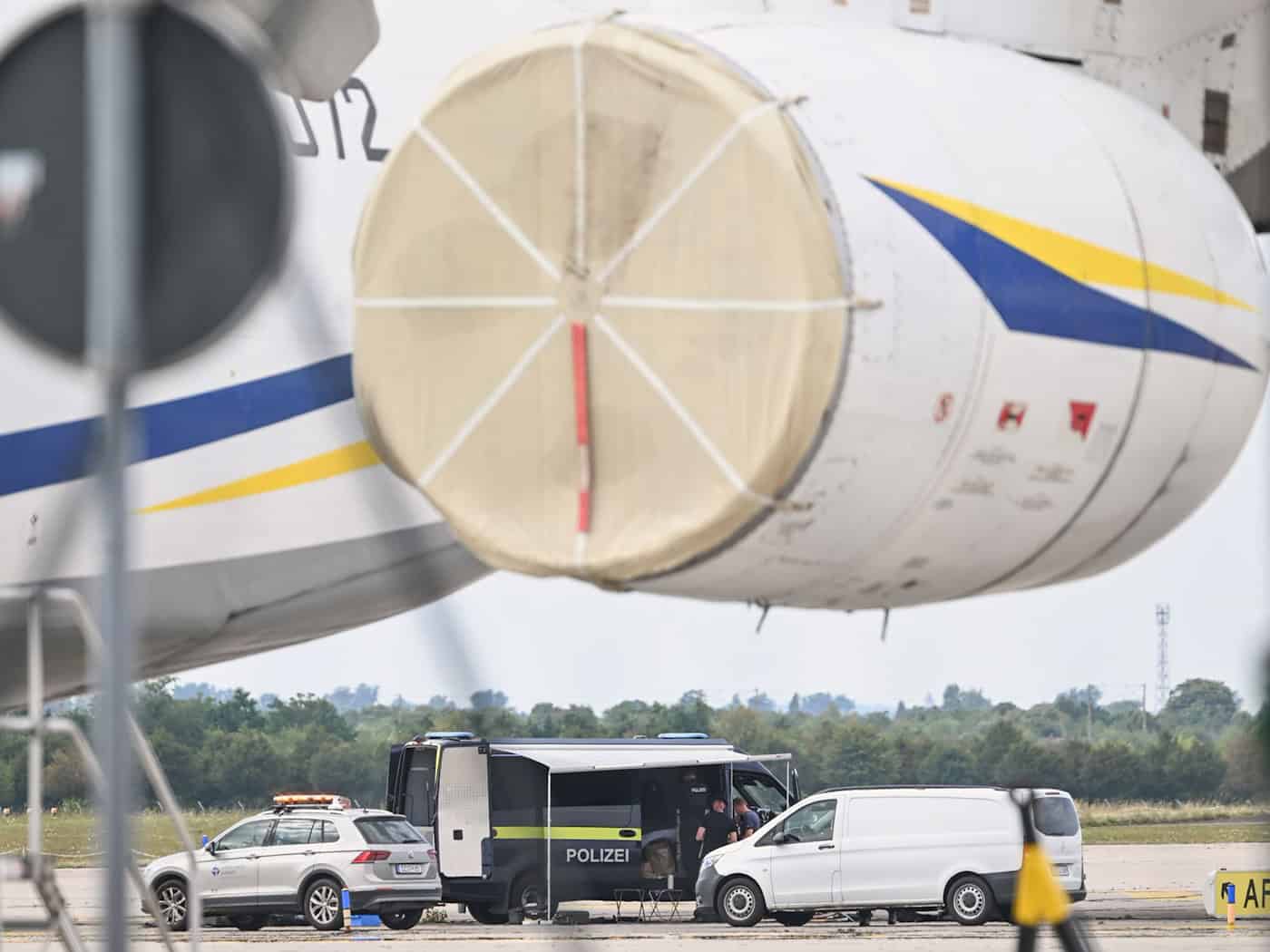
Following the discovery of a drone carrying an explosive device at Leipzig/Halle Airport, Dresden-based aviation expert Hartmut Fricke sees a new dimension to the threat to critical infrastructure. Unlike previous drone incidents, the issue is no longer limited to the risk of a collision with an aircraft or damage caused by the drone itself. An explosive device significantly increases the potential danger, the professor of aviation technology and logistics at TU Dresden told the German Press Agency. Federal Interior Minister Alexander Dobrindt (CSU) also spoke that evening of a “new level of danger” and a “hybrid attack scenario.” A drone carrying an explosive device was discovered at Leipzig/Halle Airport on Wednesday. Specialists from the Federal Police defused the detonator. According to information from security sources, it was located near a Ukrainian Antonov AN-124 transport aircraft. Investigators are also searching for parts of a possible second flying object that may have collided with a cargo plane. From an expert’s perspective, the investigation must now focus primarily on determining where the drone came from, how it was able to enter the airport’s no-fly zone unnoticed, and why it was only discovered on the runway. In addition, it must be examined how reliably existing security systems can detect small multicopters in the first place. Only then can the security situation be properly assessed. Should a targeted attack attempt be confirmed, the incident would show “that we are not yet very good at detecting such small objects near critical infrastructure,” said Fricke. This applies both to the available technologies and to the speed with which they are implemented in practice. In principle, suitable technologies for drone detection are already available. Radar, laser, camera, and infrared systems could be combined to detect drones as early as possible. Algorithms can also be used to predict their flight paths. “Development is progressing well at the prototype level, but implementation in the market or in facilities needs to happen faster,” said Fricke. From Fricke’s perspective, new systems should move more quickly from research to practical application. Not all functions need to be available from the start. Instead, he advocated for a “phased implementation” of new technologies. Fricke identified predicting the flight path of a drone that has already been detected as one of the biggest technical challenges. This capability, in particular, is crucial for enabling security forces to respond in a timely manner. Looking ahead, the aviation expert expressed little optimism. When asked whether similar incidents are likely to occur more frequently in the future, he replied: “Unfortunately, yes—as long as Russia’s aggression does not stop.” Copyright 2026, dpa (www.dpa.de). All rights reservedIncident Puzzles Authorities
Technology Available—Implementation Takes Too Long
Further Incidents Feared


