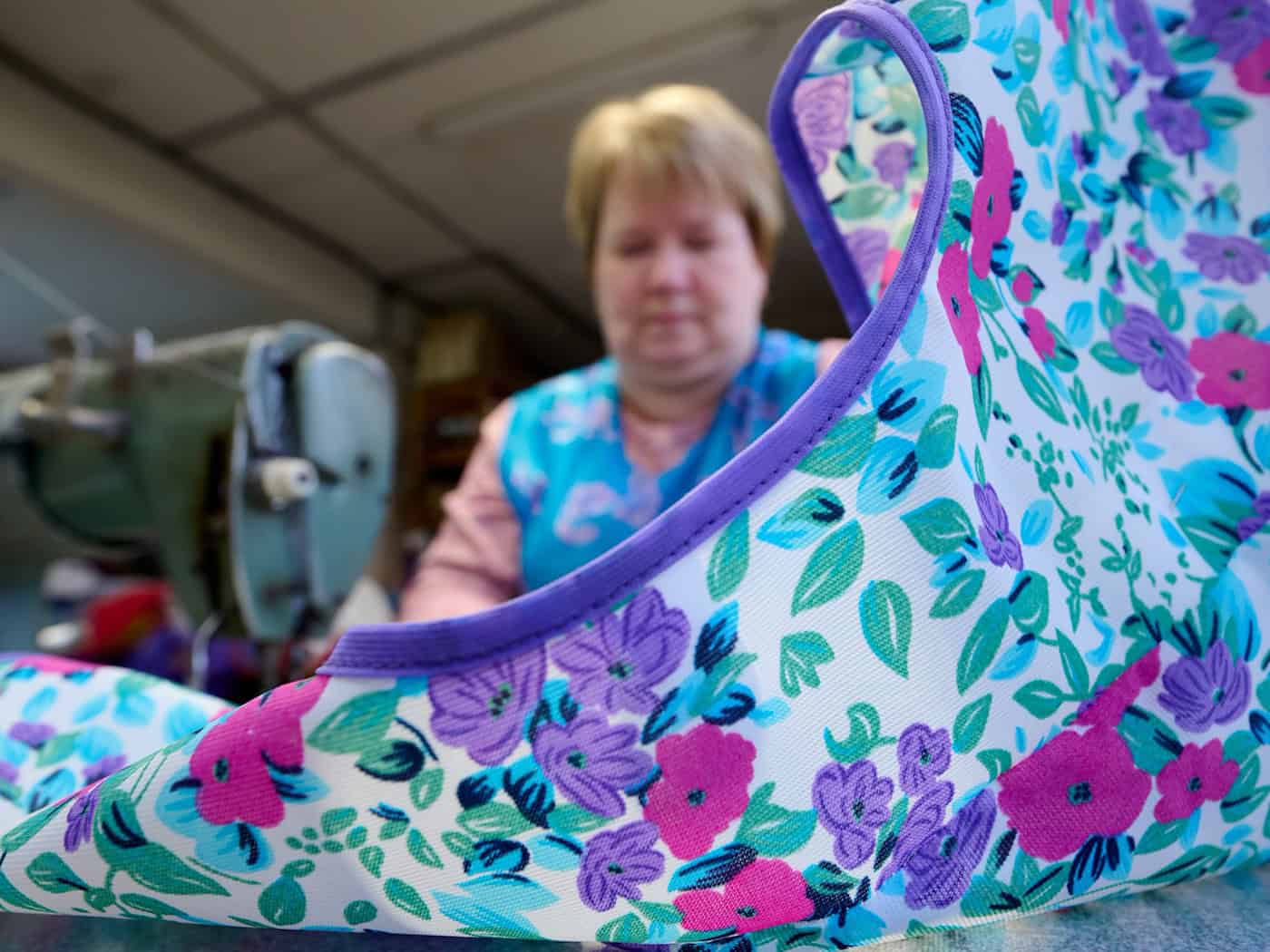
The smock apron was once a staple of everyday life in the GDR. Women wore them at home and at work, and children wore them in kindergarten and after-school care. In the summer, recalls Birgit Mädler from Eibenstock in the Ore Mountains, in some workplaces it was enough to simply wear underwear underneath. Her parents’ apron factory, H. Schuster, once supplied children’s aprons made of Dederon fabric throughout the entire republic. When these were no longer needed in kindergartens after reunification, the small business reinvented itself: women’s aprons became the focus of production. The traditional smock-style apron models are still on the shelves in Eibenstock: with button plackets, sleeveless, and often featuring colorful patterns. With her apron manufacturing, Mädler has found a niche, she says. Together with seamstress Andrea Grimm, the business produces up to 400 pieces a year, which are sold throughout Germany. And in the spring and summer collection of 2026, the international fashion world seemed to take an interest in aprons and smock dresses once again. Italian labels such as Miu Miu and Calvin Klein featured them on the runway. But Birgit Mädler doesn’t want to call it a true revival of the East German smock apron. “Our customers are mostly older women with ties to the GDR—or people looking for a gift for them.” Demand fluctuates, the business owner reports. When the smock is featured in the media, it leads to an increase in orders. “Then we make do with that for a while.” The original lab coat apron is sold through online retailers specializing in GDR products—or customers contact Eibenstock directly. Seamstress Andrea Grimm has the moves down pat: cut and seams—everything is made just as it was in GDR times. However, that also has a downside, says Mädler with a laugh: “The apron lasts up to fifteen years, and unfortunately, our customers don’t need a new one that quickly.” In general, the traditional Dederon smock apron is extremely easy to care for, as it’s wrinkle-free, stain-resistant, and quick-drying, the owner adds, listing further advantages. In Frankenberg, in Central Saxony, the Innotex printing plant also preserves a piece of GDR textile history. Among the roughly 40,000 stencils used to apply fabric patterns, there are also numerous ones from the GDR era. This is where the printed Dederon fabrics for the Eibenstock apron production are made, says Managing Director Justus Rau. The company is now the only one that still uses these fabrics for lab coats. “Of course, there were far more of them until the 1990s,” says Rau. Today, about 2,000 meters of Dederon fabric are printed annually for lab coat production—a negligible fraction of the roughly three million meters of fabric that Innotex prints each year. “If interest picks up, however, the old patterns can be reprinted at any time.” At times, the garment has been in demand, for example, at Carnival events or lab coat parties. New designs could potentially reignite interest in the coming years, according to Rau. Birgit Mädler, on the other hand, continues to rely on the classic cut and familiar patterns. She notes that there are indeed inexpensive aprons from the Far East, but her customers particularly appreciate the craftsmanship. Hardly anyone reacts “neutrally” to the smock apron, says Birthe Hemeier, museum director of the Gebrüder Pfau Cloth Factory in Crimmitschau. In the former textile factory, which is now a museum, smock aprons have long been part of the exhibition. “Visitors enjoy slipping into one of our aprons and stepping into the role of a GDR textile worker.” The Smock Apron Day held in the summer demonstrated just how great the interest in this garment is. “Many people associate personal memories with the apron.” For example, memories of their grandmother, who always had candy in her apron pocket. Lab coat aprons from Eibenstock are available for purchase in the museum shop. The demand has even surprised her, says Hemeier. Some visitors come by specifically for this reason. From Leipzig trendsetters to a design student from Schneeberg—on Kittelschürze Day, she “encountered a rather unusual clientele,” adds the museum director. “That’s why I definitely sensed a hint of a trend surrounding the smock.” In the future, the museum also plans to conduct scholarly research on this unique garment. A research project is planned that will, among other things, examine the garment’s significance for the role of working women in the GDR. “The apron was part of self-presentation.” The fact that women sometimes wore them in public spaces could play a role here, as could possible differences from West German clothing culture. At the Schneeberg Faculty of Applied Arts at the West Saxon University of Applied Sciences in Zwickau, students recently explored the region’s textile heritage as part of a project, reports Professor Katharina Jebsen-Plättner. “The GDR smock apron was also a topic in this context.” One distinctive feature was the variety of colors and patterns: “Despite being mass-produced, a touch of individuality and a personal flair were still possible.” Even today, young people can discover the apron as a garment by engaging with regional traditions. “It plays an important role in traditional costumes.” Copyright 2026, dpa (www.dpa.de). All rights reservedDederon with traditional patterns
The lab coat apron—back in style soon?