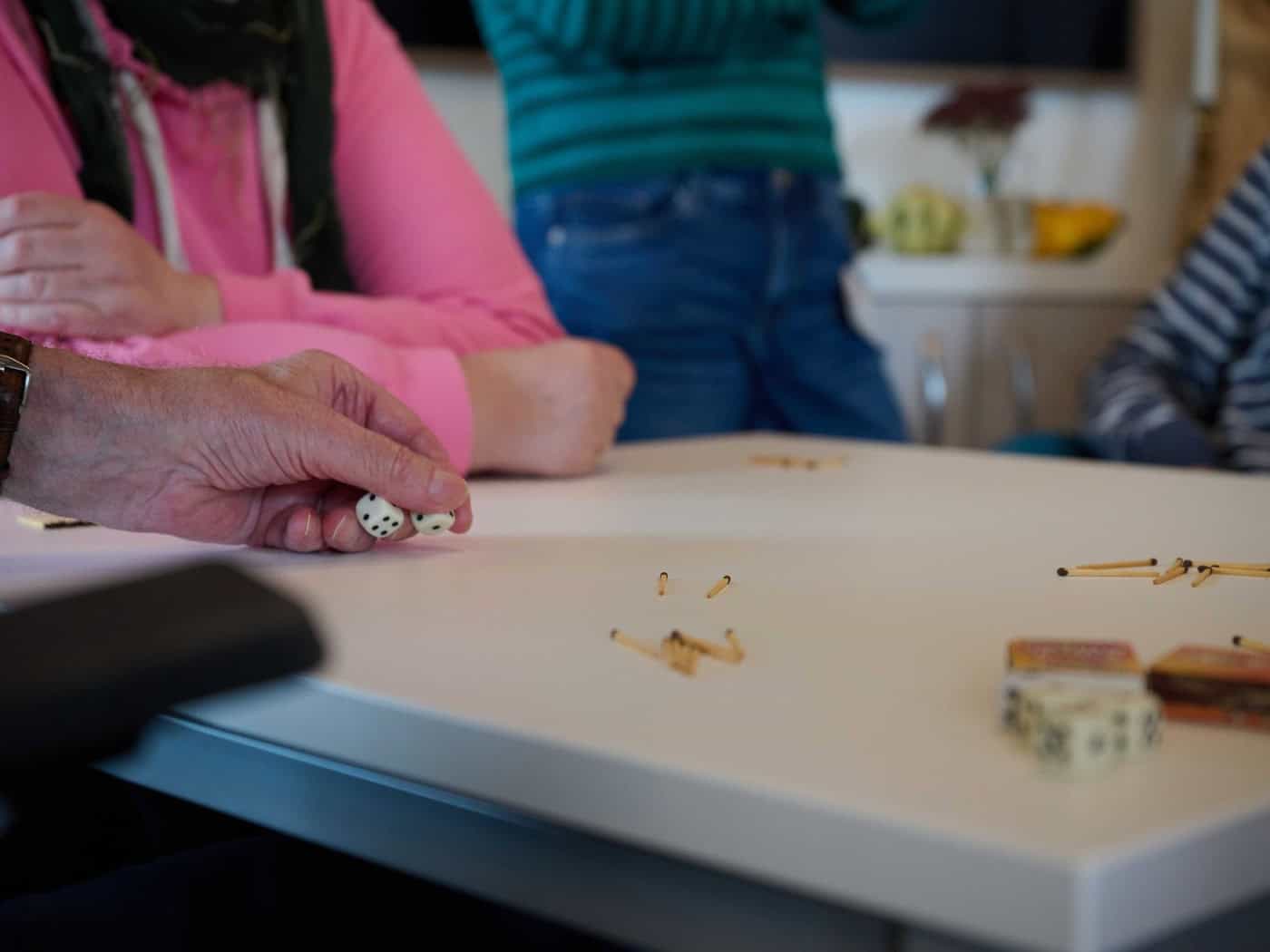
While hospice volunteer Brigitte Hartwich is talking with a guest at the Marien Hospice in Dresden, the man suddenly bursts into tears. He is seriously ill, but has not been at the hospice for very long. Hartwich knows that being separated from his wife is taking a toll on him. On this particular day, however, he is crying because he no longer receives the daily newspaper there that he used to read every day. After their conversation, the volunteer caregiver gets him his usual reading material, as she explains. When she hands him the newspaper, he breaks down in tears again. For about five years now, Hartwich has been coming to the Marien Hospice once a week to visit the residents there. Twelve people with life-limiting illnesses are staying there as inpatients. “It’s really important to recognize what brings joy to someone within those limited possibilities—or sometimes just a different way of thinking. That’s our job—that’s how I see it,” she says, describing her volunteer work. First and foremost, she is there as a conversation partner for the residents. It’s important not to judge or express opinions that might trigger negative thoughts in people. “Just listen,” she says. Advice should only be given in the sense of encouraging someone to talk again with the person with whom they’re having a problem. On top of that, there are the little joys she brings to the people there, such as a walk or the daily newspaper. Eva Ebertseder volunteers at the day hospice of the Marien-Hospiz. Her day usually begins with breakfast together, she says. There’s plenty of conversation there, too. Guests and volunteers plan the day together: they go for walks, do crafts, or play games. The absolute classic at the hospice—Ebertseder and Hartwich agree—is the classic board game “Mensch ärgere Dich nicht.” According to the State Ministry of Social Affairs, there are 15 inpatient adult hospices and 54 outpatient hospice services in Saxony. According to its spokesperson, Sarah Zinn, the Marien Hospice is the only inpatient hospice in the state capital. According to the ministry, more than 2,700 volunteers work in outpatient services alone. The ministry does not have any figures available for inpatient hospices. According to Zinn, there are currently 20 volunteers active at the Marien Hospice, working in various areas. Not all volunteers provide companionship to residents; some also come for specific creative activities or to perform specific tasks, such as caring for plants. When she tells outsiders about her volunteer work, Ebertseder says she usually hears two responses along these lines: “Don’t even get me started on that” or “Well, I couldn’t do that.” We’re all familiar with comments like that, she says. Ebertseder and Hartwich both decided to volunteer at the hospice after a death in their families. “I really enjoy doing this because the vast majority of people are so grateful that there’s someone who takes the time and simply gives them their time,” says Ebertseder about her motivation. Hartwich, who worked as a nurse and podiatrist until she retired, says she wanted to continue having a purpose and being part of a team even after her working life ended. Ebertseder emphasizes that interacting with such a diverse group of people is enriching: “I’ve gotten to know so many people now, and everyone has a truly fascinating life story. That’s what I love about it.” Her own relationship with death has also changed as a result of her volunteer work. The 56-year-old says: “It has become much easier for me to simply accept this and to truly internalize that it is part of every single life—and that it’s not something you can push aside, but rather it’s simply part of life.” Before beginning their work, the volunteers in Dresden complete about 100 hours of training, explains Ansgar Ullrich of the Christian Hospice Service in Dresden, who is responsible for training the hospice companions. Hartwich and Ebertseder completed their training here. According to Ullrich, the training prepares future hospice companions for their work not only by providing knowledge about the end of a person’s life. The preparation also focuses on the volunteers’ self-awareness—their relationship to death and grief, their own strengths, and their limits. That is why participants must also spend a seminar weekend with a psychologist reflecting on themselves. “So you also think about what you’re willing to reveal about yourself or how deeply you can get involved. After all, there are limits for us, too,” Hartwich explains. The demand for training spots in Dresden is high, says Ullrich. The two training courses being offered in 2027 are already full. And Hartwich and Ebertseder have no intention of giving up their volunteer work either. “As long as I’m physically able, I think I can keep doing this for a while,” says Hartwich. Copyright 2026, dpa (www.dpa.de). All rights reservedBringing Joy Despite Limited Options
Thousands of Volunteers in Hospice Care
Why do people choose this volunteer role?
Volunteers with Special Training