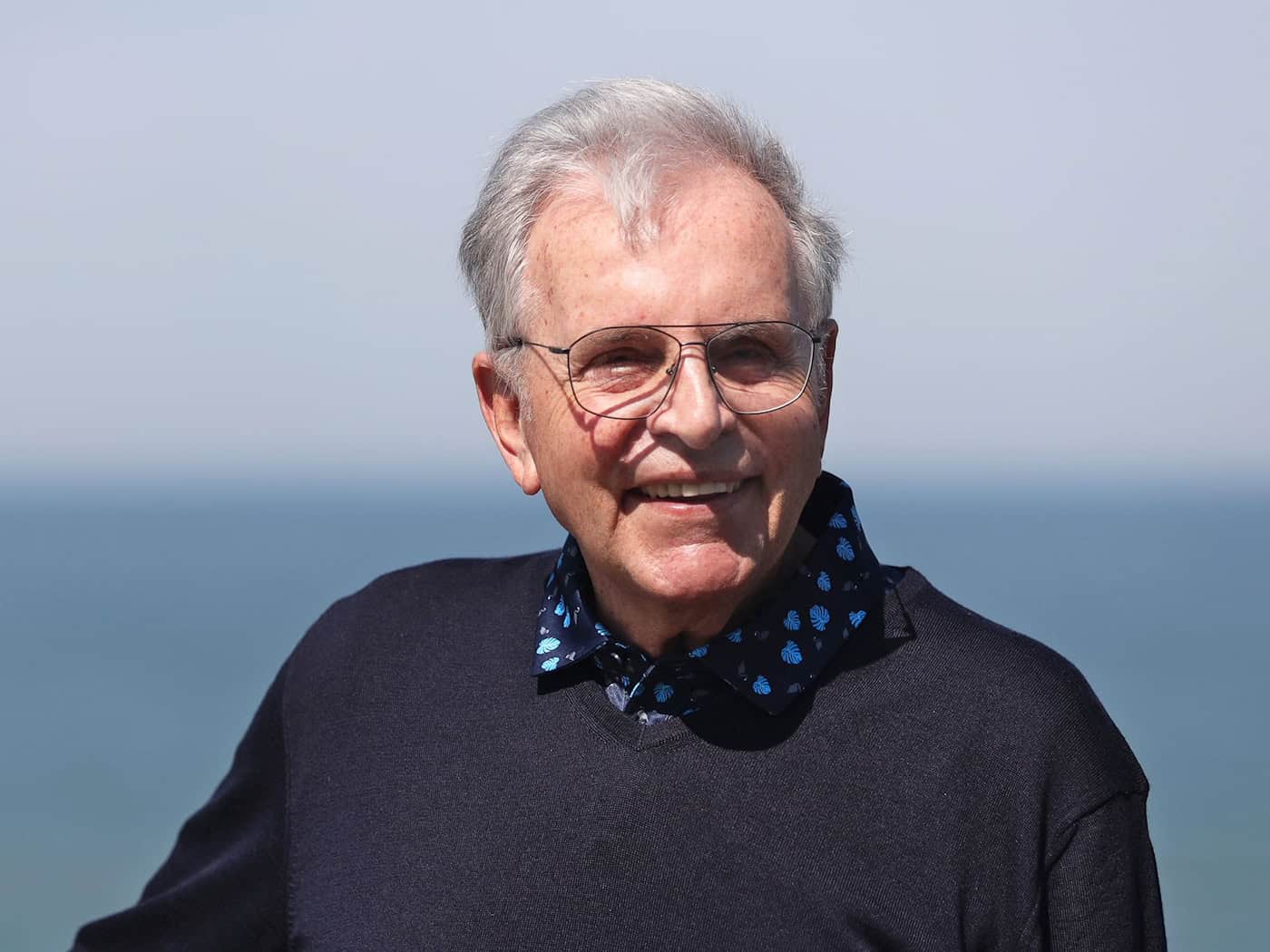
Birthday gifts like this are certainly rare. To mark his 80th birthday on Monday, MDR dedicated a 45-minute documentary to one of Germany’s all-time greatest soccer goalkeepers. The club designed a special fashion collection, and the regional league team is playing in special jerseys. And all of this for a man who means so much to the club and the city—and who attended the preview screening at a Zwickau movie theater alongside 250 others—Jürgen Croy. Grand words were never his thing—not even that evening. Jürgen Croy preferred to let his actions speak for themselves. As a soccer goalkeeper, as a coach, and as mayor of his hometown, Zwickau. Croy was a man of the people, and GDR soccer fans recognized that. After the fall of the Berlin Wall, they voted the goalkeeper of the former BSG Sachsenring Zwickau “Best Soccer Player of the GDR.” A goalkeeper—and not the equally world-famous field players Jürgen Sparwasser, Hans-Jürgen Dörner, Joachim Streich, Peter Ducke, or Eberhard Vogel. To this day, Croy enjoys the public, the fans, and his former teammates. At the movie theater, he signed countless autographs—a selfie here, a bit of small talk there. Lean and lanky as in his prime as a soccer player, mentally sharp and eloquent. To this day, he remains a soccer player who spent his entire career with a company sports club—not with the major clubs of the GDR—and yet still earned the title “world-class.” Grand emotional outbursts were never his trademark. Instead, he was known for his calm and objectivity. Jürgen Croy was someone who knew what he wanted. And someone who pursued and achieved his goals with perseverance. There are few goalkeepers who embody these qualities. “A goalkeeper doesn’t have to be extroverted; he doesn’t have to be a showman,” says Croy. The 94-time GDR national team player impressed instead with his practicality, excellent positioning, and effective saves. He didn’t need any flashy acrobatics to win the crowd’s applause. He celebrated successes nonetheless. During his career from 1965 to 1981, he became an Olympic champion (1976) and an Olympic bronze medalist (1972), played in the 1974 World Cup, including the legendary 1–0 victory in the only inter-German match against West Germany in Hamburg, and even reached the semifinals of the European Cup Winners’ Cup (1976) with Sachsenring Zwickau. “It was important to me to be where my family felt at home, where everything fit. And that was in Zwickau. I always played in the Oberliga and won the cup twice with my club,” Croy reports, not without pride. That didn’t sit well with everyone, especially not with the GDR sports leadership. “The German Gymnastics and Sports Federation of the GDR even threatened me with reprisals in quite blunt terms. Fortunately, I’d already been a national team player for a long time and was able to fend off the pressure. It probably wouldn’t have made sense if the country’s best goalkeeper had stopped playing for the national team,” Croy recalls. He was always a straightforward guy who, long after the fall of the Berlin Wall, continued to offer insights into the life of athletes in the GDR. “A salary of around 1,500 East German marks; national team players received an extra 1,000 marks per month, and for each international match, another 1,000 to 2,000 marks on top of that—depending on the opponent’s strength,” Croy once recounted during a talk at Rostock’s Ostseestadion, and he also explained what he did with the 8,500 Mark bonus for the 1974 World Cup: Among other things, he used it to buy a pool, which was still being used for swimming long after the fall of the Berlin Wall. After his playing career and under the new political system, he worked as a physical education teacher, coach for Sachsenring Zwickau, a representative for a sporting goods company, publishing director of a West Saxon newspaper group, mayor for culture, schools, and sports in Zwickau, and managing director of the city’s cultural, tourism, and trade fair operations. “I was fortunate to have had interesting professional experiences,” says Croy. “I always enjoyed going to work.” Copyright 2026, dpa (www.dpa.de). All rights reservedA man without pretensions
A Straightforward Guy