

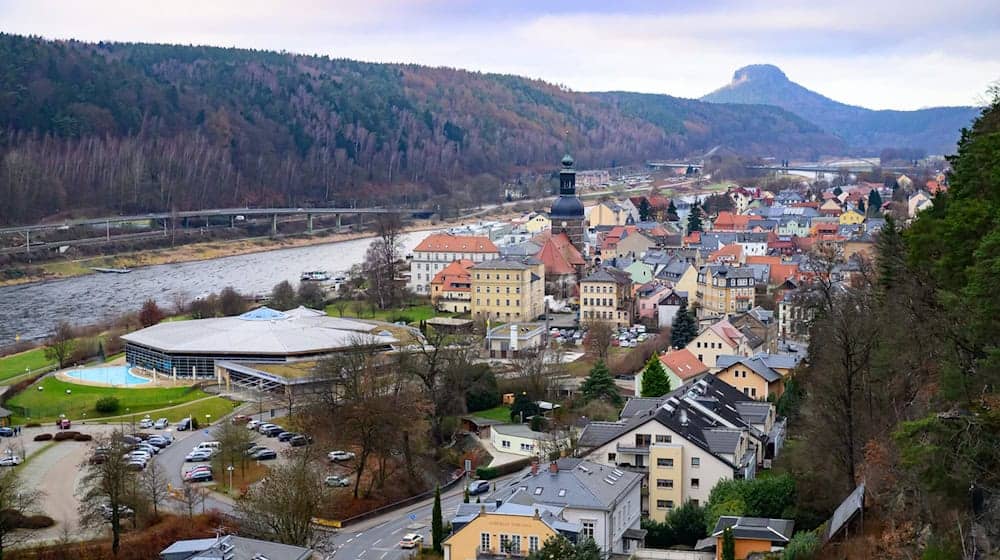
There is a lot of work to be done in Bad Schandau that hardly anyone sees. Rubbish bins have to be emptied, paths checked and flower beds replanted. "We deliver the quality expected of a spa town - but we can hardly afford it," says Andrea Wötzel, the town's administrative coordinator. Parking lots, public toilets, buildings - everything should be kept in an attractive condition for visitors. But the spa town in the Saxon Switzerland-Eastern Ore Mountains district is struggling with additional costs of around 1.8 million euros a year, according to its own figures. That is a considerable sum for a municipality with just over 3,000 inhabitants, says Wötzel. The visitor's tax could only cushion part of this. There is hardly any political approval for higher rates, and the hosts fear losing guests. The process of being recognized as a Kneipp spa alone cost the popular health resort in eastern Saxony around 75,000 euros. Like many other Saxon health resorts, Bad Schandau is faced with the question of whether it will even be possible to retain the title of health resort in the future. "We are continuing to lose touch and will be at a competitive disadvantage in the long term," says Helfried Böhme, Managing Director of the Saxon Spa Association. According to surveys carried out by the association, all 14 Saxon spas together lack around ten million euros annually, which are not covered by the current tax models. A separate financial equalization system - which has long been common practice in several other federal states - is still lacking in Saxony. The spas bear a particular burden, as Böhme explains. "They have to provide and process remedies, maintain extensive green spaces, ensure a comprehensive range of cultural and health services and often maintain historically sensitive infrastructure." In addition, there is growing pressure to modernize. Many spas, thermal baths and health resorts were opened around the year 2000. After 25 years, water, heat and intensive use are taking their toll on the building fabric. "There is often a lack of own funds to even apply for funding," says Böhme. The result is a "phase of stagnation", which is noticeable in several places. The spas association is now relying on the state's upcoming double budget. A look at Bad Schandau shows just how serious the situation is: some investments have already "become impossible", according to Wötzel. The planned Kneipp center, which was to be built in two listed buildings, has been calculated at around eight million euros. Due to declining funding rates, the small municipality is currently no longer able to raise its own contribution. "If the Free State does not provide any financial compensation in the future either, the municipalities affected will have to ask themselves why they should still be awarded a predicate," says the town hall. Saxony would lose flagships that also support surrounding regions in terms of tourism. According to the spa association, the spas in the Free State recorded around 3.2 million overnight stays last year. For the first half of 2025, around 1.5 million overnight stays were counted in facilities with more than ten beds. In the health spas, visitor numbers are almost at pre-corona levels, according to the spa association. Some places such as Bad Elster or Bad Brambach even registered strong growth. Many guests also made good use of the spas thanks to a rainy summer, according to Jens Böhmer, Managing Director of Sächsische Staatsbäder GmbH. Further modernizations are planned for 2026, including the expansion of the sauna world in the Soletherme Bad Elster. Böhmer says: In addition, a new motorhome parking area and a boutique hotel are being developed in cooperation with partners. And even if the state spas have a unique selling point in Saxony: The company also considers financial equalization for spas to be "sensible and necessary", as the municipalities must constantly develop the infrastructure "to meet the growing expectations of health tourism". The state spas are increasingly focusing on individuality when it comes to spa offers: in addition to a "private spa", new "digital diagnostics" are also available. "We offer guests a variety of diagnostic procedures to measure biometric body data, the results of which are collated on a platform. This results in an individual training and treatment recommendation," explains Böhmer. Copyright 2025, dpa (www.dpa.de). All rights reservedLame coffers at Saxony's health resorts
Will flagships be lost?
Reliable visitors and plans for 2026


