

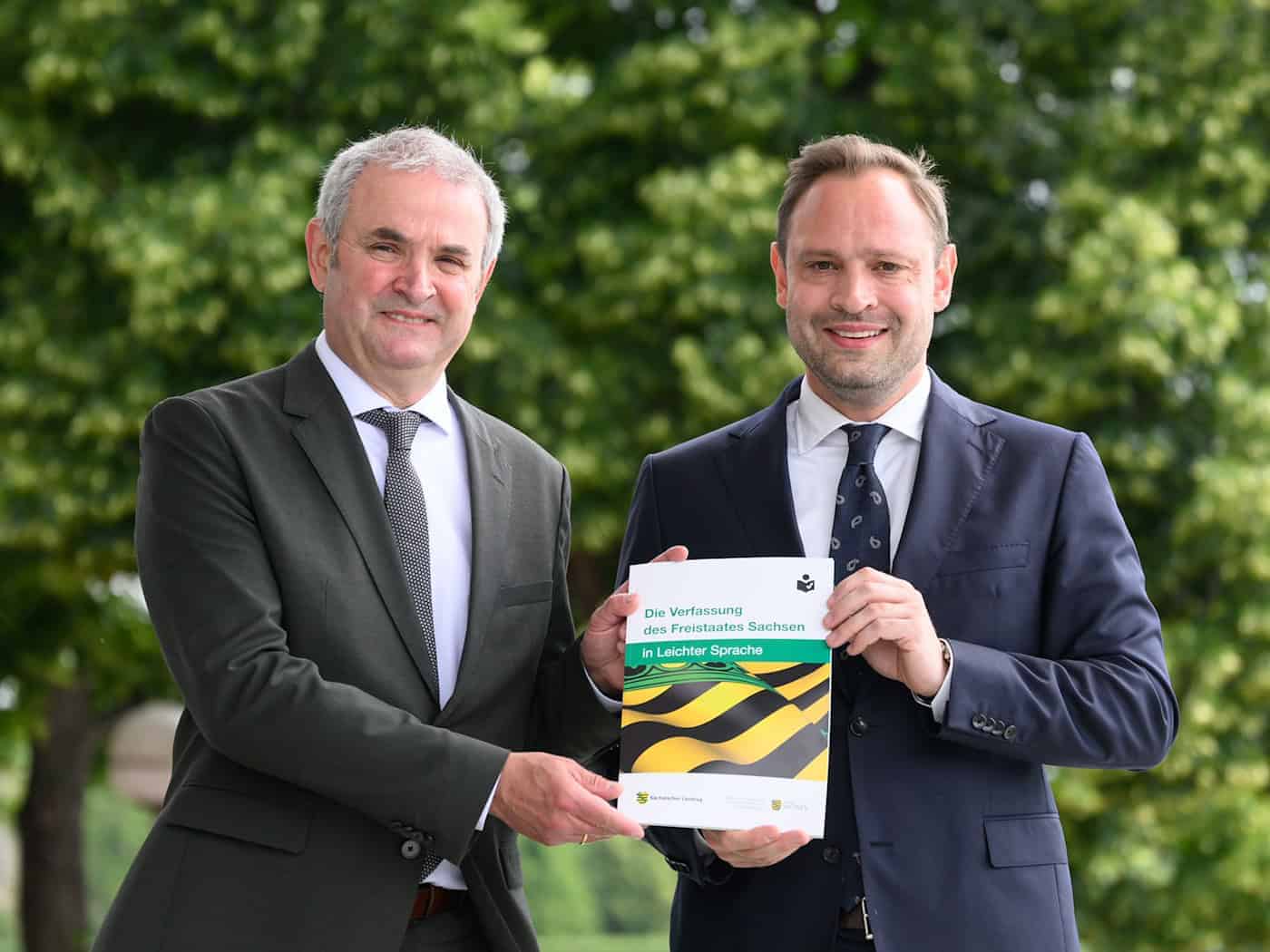
Saxony is making its state constitution accessible to people with disabilities. The Free State of Saxony is now the fourth German state to publish its constitution in plain language. State Parliament President Alexander Dierks sees this as a step toward improving opportunities for participation. It is desirable that even more people become involved in the democratic community and feel represented by it. Until now, only the states of Lower Saxony, North Rhine-Westphalia, and Baden-Württemberg had made their constitutions accessible in this way. Saxony’s state parliament adopted the Constitution of the Free State of Saxony in 1992. Article 7 of the Constitution also sets forth the state’s objective of creating equal living conditions for people with disabilities. The version now presented in plain language enables, above all, people with cognitive impairments, limited German language skills, or other comprehension barriers to better access the fundamental rules of the state. Dierks envisions that in the future, summaries of laws and other resolutions of the State Parliament will also be published in plain language on the parliament’s website. Article 1 of the Constitution reads as follows in the original: “The Free State of Saxony is a state of the Federal Republic of Germany. It is a democratic, social state governed by the rule of law, committed to the protection of the natural foundations of life and culture.” In plain language, it states, among other things: “Saxony can make its own laws. However, Saxony must comply with the laws that apply in Germany. In Saxony, people make decisions together. That is democracy.” Article 95, which deals with borrowing, is paraphrased in plain language as follows: “Saxony should not spend more money than it takes in. However, it may happen that Saxony has taken in much less money in a given year than usual, or that something bad has happened, such as the Elbe floods or the COVID-19 pandemic. In such situations, Saxony needs more money. That is why Saxony is then allowed to borrow money on an exceptional basis.” According to Michael Welsch, the Free State’s Inclusion Officer, the Constitution in plain language enables people to know and exercise their rights. “Inclusion and democracy are two sides of the same coin.” Anyone who denigrates inclusion as an ideological project undermines human dignity. According to Welsch, inclusion is not having an easy time of it right now. “Times are getting tougher, but we must not lose sight of our compass pointing toward inclusion,” he said, referring to the strained financial situation at the federal, state, and local levels. People are talking about reducing bureaucracy and increasing administrative efficiency. These are important concerns. However, we must be careful not to lose sight of inclusion. There are rules for plain language. Short sentences should contain simple words and convey only one piece of information. Long or complicated terms should be avoided. Sentences are formulated in the active voice. Idioms, figurative language, technical terms, foreign words, and abbreviations do not appear in plain language. Copyright 2026, dpa (www.dpa.de). All rights reserved“Saxony should not spend more money than it takes in.”
Inclusion should not depend on the financial situation


