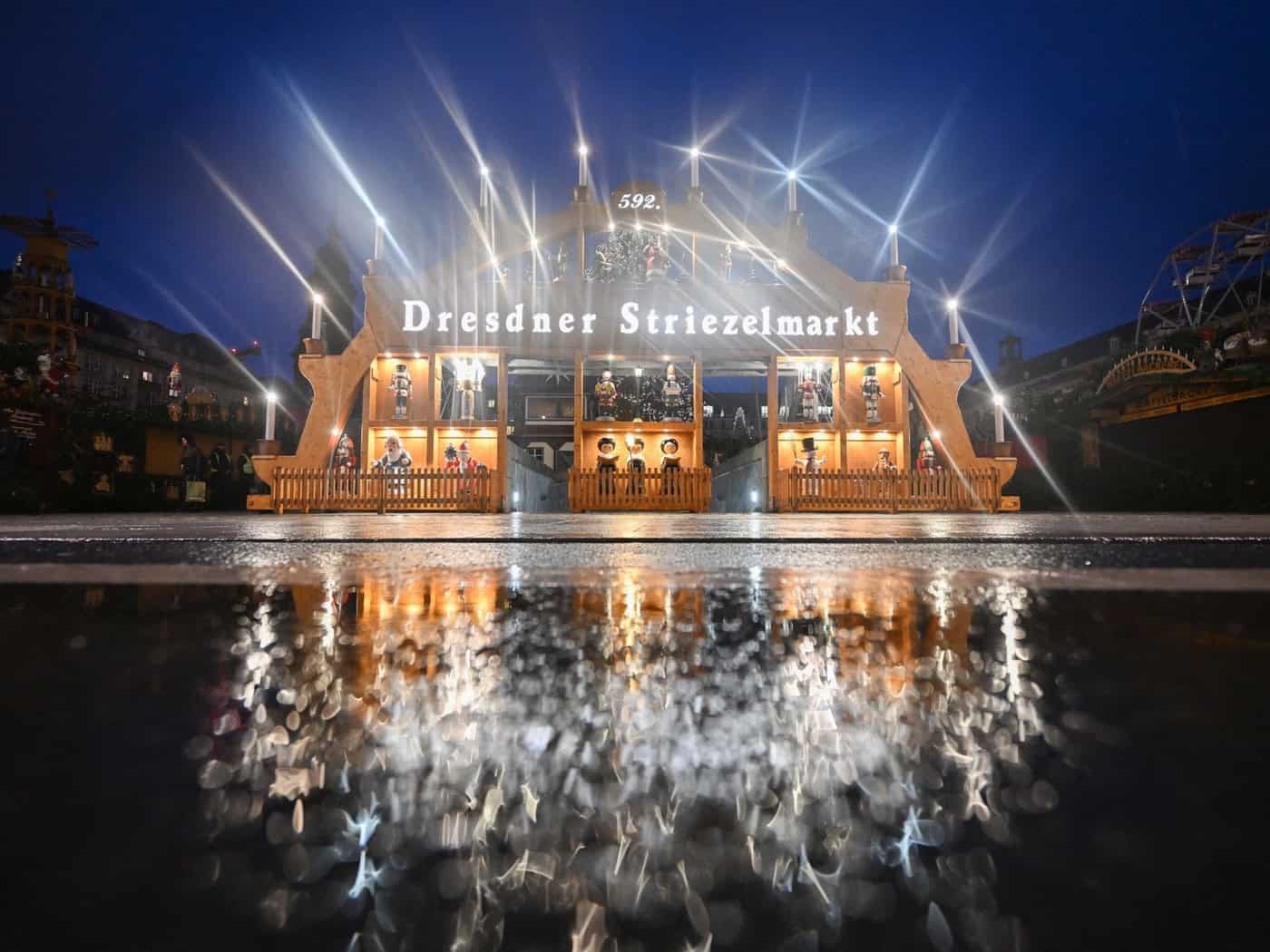
One thing is certain, even after 592 years: The Dresden Striezelmarkt will continue to attract plenty of visitors in the future. The city, as the organizer, expects about two million guests this year, although no one can determine the exact number of visitors. Anyone familiar with the market from previous visits knows how crowded it can get on certain days and at certain times. No one can feel alone here. The mulled wine loosens the tongues of even those who are usually rather taciturn and trudge through the Advent season in a Grinch-like mood. Stefan Heilig, who has been in charge of the markets in Dresden for six years, has had an interesting experience. “The Striezelmarkt is an absolute hit on social media. There are an incredible number of Reels on TikTok, Instagram, and Facebook. The market is overrun by young people who are discovering this Christmas spirit, this tradition, for themselves,” reports Heilig. In fact, there are constant changes—not just in the growing selection of vegetarian dishes. For Heilig and his colleagues, the question arises: How can a market with such a long tradition be brought into the modern era? After all, even the Striezelmarkt isn’t a surefire success on its own. In Dresden, they are determined to hold fast to certain things. “We make sure that the Striezelmarkt remains a showcase for Saxon craftsmanship.” This year alone, 26 vendors are offering wood carvings from the Ore Mountains. Food stalls account for just under 30 percent of the market. The market is anything but a food court. The market’s staging alone contributes to this atmosphere. When the market opens next Wednesday, the opening ceremony will follow a time-honored ritual. First, there will be an ecumenical service in the Kreuzkirche, featuring the Catholic choirboys and the Kurrende choir from the Auferstehungskirche Dresden Plauen. Afterward, the municipal Kreuzchor—led by a miners’ orchestra and accompanied by the Dresden Master Bakers—marches onto the large stage of the still-unlit market. “Then there’s a short Christmas concert where people sing along,” says Heilig, describing a moment that gives you goosebumps. “You can see people holding hands there. That, in particular, is our message: together, not against one another,” says the 50-year-old market director. People of all faiths should experience the Striezelmarkt as a place of community for four weeks. Heilig has observed that complete strangers meet at the market. “Many different languages are spoken here. That’s a vibrant part of Dresden’s welcoming culture. That’s very beneficial for our society.” Until then, precise preparatory work must be done. First comes the tree—as early as the end of October. Then the themed pavilions follow. The market is built from the inside out. “The stall locations are surveyed using GPS and satellite data. The huts are marked out and must be placed exactly there. Otherwise, the special concept can’t be implemented,” says Heilig. In the past, the market with its grid layout looked like a New York-style city block; now, you can almost get lost in the winding alleys and squares. Of course, in Dresden—as in other German cities—the Striezelmarkt is also about buying gifts, drinking mulled wine, and meeting friends, says Heilig. “But it’s more than that. It’s this peaceful time with family that you also want to consciously experience with friends.” In Dresden and Saxony, the Advent and Christmas season is celebrated in a special way—with many traditions that keep the markets from becoming mere fairgrounds. At the Striezelmarkt, the lighting now comes from LED lights, but flashing light shows are off-limits. The market stalls also remain true to tradition. They must all have a red roof and may only be decorated with natural brushwood. Only one historic Ferris wheel and two family carousels can be found at the market—the former has been operated by the same family for four generations and still runs on its original engine. “It’s important to preserve traditions, but we also have to keep up with the times when it comes to our offerings,” says Heilig. Change has essentially always been part of the program. When the market first took place in 1434, it lasted only one day. The Saxon Elector Frederick II—known as “the Meek”—and his brother Duke Sigismund granted the city of Dresden a free market day in the run-up to the festival. “It was purely a meat market. The people were to have the opportunity to stock up on meat after Lent,” reports Heilig. “Apart from the food stalls, all the other vendors offer either woodcrafts and Christmas decorations or Christmas stollen, hats, scarves, honey, teas, coffees, beautiful items to discover, and in some cases things you simply can’t find in regular stores,” explains Heilig. This year, after a long absence, the market once again features a vendor offering Lauscha glass art—including Christmas tree ornaments. Vendors must reapply every year and are selected strictly according to guidelines. More than 270 applications were received for the 592nd market. Vendors must also include a design concept for their booth. In the age of AI, some vendors are getting incredibly creative. “Some booths look like palaces. Even top-tier, tanned models are included in the visualizations,” says Heilig. However, they want proof of how this can be implemented. Christmas peace did not always reign at the Striezelmarkt. Occasionally, scuffles broke out among vendors. In the so-called “Striezel dispute,” Dresden vendors complained to the city council that vendors from other regions were being admitted. One such dispute is recorded from the year 1624. Dresden bakers and artisans complained about competition from outsiders. “The council made a surprisingly progressive decision back then. It said: We won’t turn away the outsiders, because competition stimulates business,” says Heilig. “A lot of things still happen in person here. But what makes the market modern is that we make it digitally visible and organize it in its traditional way,” says Heilig. Young people, too, are fascinated by such authentic attractions as the world’s largest step pyramid, the walk-through “Schwibbogen,” and the live demonstrations. “We have live baking and woodturning demonstrations.” There’s an elf movie theater and a craft house, as well as a puppet theater, an Advent calendar, and a Christmas bakery. The main stage features a program developed specifically for the Striezelmarkt. A “Newcomer Hut” is designed to give young vendors the opportunity to offer their products for free for one week. Not all products make it to the market, however. Heilig tells of an applicant who wanted to sell wooden sex toys to market-goers. Another applied with an alternative Christmas tree, which, however, bore only a rudimentary resemblance to such a tree. This year, the Pflaumentoffel serves as the central theme—a historical figure made of prunes that looks like a chimney sweep and is considered a good-luck charm. “The Pflaumentoffel brings generations together and brings a piece of Dresden’s Christmas culture to life,” says Jan Pratzka, the city’s mayor for economic affairs. Copyright 2026, dpa (www.dpa.de). All rights reservedThe Market Aims to Be a Showcase for Saxon Craftsmanship
Preserving traditions while still moving with the times
Vendors must reapply every year
Christmas Peace Disrupted by the “Striezel Dispute”
No Room for Sex Toys