

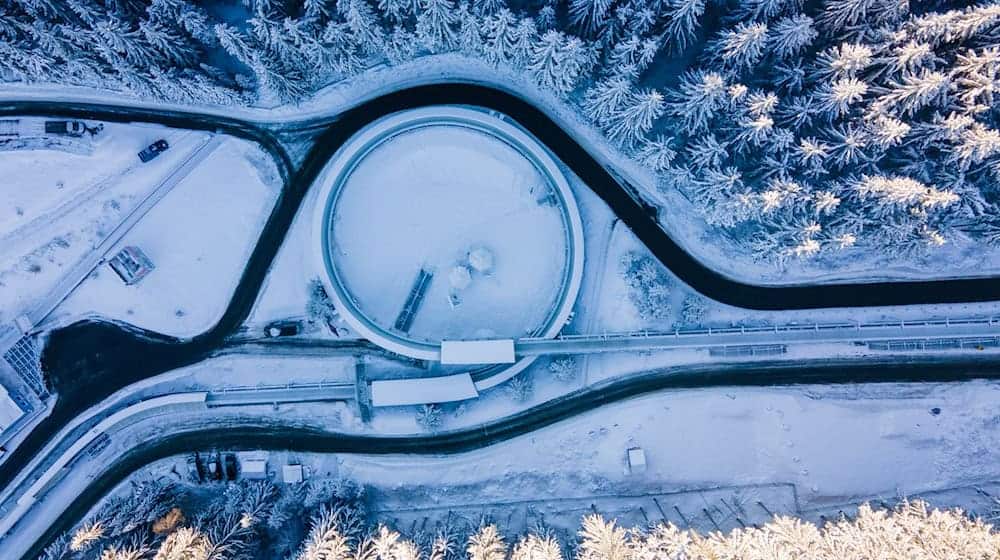
Altenberg in the Eastern Ore Mountains with its population of just under 2,000 is even known in the Virgin Islands, Brazil and Nigeria - at least among athletes who train in the small town in Saxony. The local ice track is used by pretty much every nation that races on a sled or in a bobsleigh. Speeds of up to 140 kilometers per hour can be reached on the challenging track with a total length of over 1,400 meters. It doesn't get that fast everywhere in the country. In the coming week (January 12 to 18), World Cups in bobsleigh and skeleton will take place in Altenberg. The last World Cup before the Olympic Games in Milan and Cortina d'Ampezzo in February will also determine the overall World Cup winners. "That's what makes it so special," says Jens Morgenstern, head of Wintersport Altenberg GmbH, which operates the luge and bobsleigh track. He expects several thousand spectators. Altenberg has already hosted world championships where 25,000 fans flocked to the ice track. Winter sports are also very popular in the neighboring state of Thuringia. The international competitions in Oberhof began on Thursday with the Biathlon World Cup - ahead of schedule because too much wind was forecast for the opening event on Friday. The FIS World Cup in cross-country skiing and competitions in the Nordic combined and luge World Cups will follow in Oberhof in January. The top-class sport is expected to attract thousands of visitors to Oberhof and the Thuringian Forest. The competitions with international appeal are raising high expectations, not least in the tourism industry - even beyond the time of the competitions. It is said that an audience of millions watching the TV broadcasts can see images from Oberhof and Altenberg as an incentive to visit. In Oberhof, for example, the state of Thuringia has invested heavily in recent years - not only in the biathlon stadium or the luge track, but also in the infrastructure. New hotels and guesthouses have also been built. Clips produced especially for the TV broadcasts are intended to draw attention to the Thuringian Forest as a travel destination, said the Managing Director of the Thuringian Forest Regional Association, Antonia Sturm, to the German Press Agency. "This is an important international stage for the Thuringian Forest. We could hardly achieve this advertising value with traditional marketing budgets." Surveys after major sporting events have shown that a high proportion of guests want to return to Oberhof. At the double World Championships in biathlon and luge in February 2023, 91 percent of those surveyed said they wanted to come back. The occupancy rate of hotels in the region is not only good during World Cups. Events such as the Rennsteiglauf and the Rudolstadt Festival also keep tourism going. The World Cups not only increase the popularity of the winter sports centers, but also the turnover of the tourism industry. For Oberhof, Managing Director Sturm estimates that the coming weekend alone, with the appearance of the biathlon world class, will generate a turnover of 11.5 million euros for hotels, service providers and retailers. In Altenberg, too, sporting events stimulate business and boost occupancy rates at accommodation facilities. "When winter weather, vacations and sporting events come together, we approach 100 percent. It becomes very difficult to find a bed," says Marcel Reuter, head of the Altenberg main office. "Major sporting events bring movement to Saxony - to the cities, to the regions and to tourism. They make our state visible, arouse emotions and invite locals, guests from Germany and the world to rediscover Saxony," says Saxony's Tourism Minister Barbara Klepsch (CDU). Full hotels, lively places and enthusiastic visitors are proof that sport inspires and creates lasting impulses for tourism, the economy and the image as a warm host. Michael Geisler, District Administrator of the Saxon Switzerland-Eastern Ore Mountains district, takes a similar view. The district is the owner of the luge and bobsleigh track in Altenberg. "Major sporting events are an important factor for our rural district when it comes to making a sustainable contribution to economic development. These important events make our district visible beyond national borders. They strengthen tourism, bring guests to the region, support trade, the hotel industry and revitalize the gastronomy sector." However, those responsible are aware that good marks for hosting the competitions are no cushion. "It's not the event weekend alone that determines tourism success," says Christoph Gösel, Managing Director of Thüringer Tourismus GmbH. Major events generate attention and sales. However, lasting effects only arise when the attention generates concrete travel decisions and offers are booked throughout the year." In Saxony and Thuringia, top-class sport is seen as a figurehead for the region. This justifies high investments in infrastructure, they say in unison. Over the past five years, Saxony has transferred 4.4 million euros to the district of Saxon Switzerland-Eastern Ore Mountains for investments in the ice channel. A further 15.4 million is to follow by the end of 2032. In 2024, a competitive sports center for bobsleigh, luge, skeleton and biathlon was inaugurated in Altenberg - at a total cost of 18.8 million euros. Events such as the World Cups in Oberhof, however, also show the dependence on climatic conditions. Increasingly, the aim is to develop facilities that can be used all year round, according to Thuringia. This also applies to Altenberg - even if the bobsleigh track does not need snow from above. The local refrigeration machines can ice the bobsleigh run even when the outside temperature is as low as 20 degrees Celsius. Copyright 2026, dpa (www.dpa.de). All rights reservedBiathlon World Cup to attract thousands of visitors to Oberhof
Thuringian Forest as an international stage for tourism
Events keep the tills ringing at hotels, retailers and service providers
Major sporting events bring movement to tourism
Sports events are not a sure-fire success
Millions invested in sporting infrastructure


